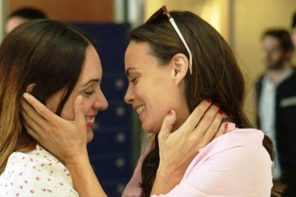

It’s the largest queer arts event in Western Canada, and in 2019 the festival features work from 27 countries, more than 50 events, and four spotlights
When: Aug 15-25
Where: Cineplex, SFU’s Goldcorp Centre for the Arts, York Theatre, VIFF Vancity Theatre, Vancouver Playhouse
Tickets: from $10, queerfilmfestival.ca
A recipe for disaster turns into a surprisingly warm and uplifting experience in Gay Chorus Deep South. The documentary follows the San Francisco Gay Men’s Chorus on a tour of the Southern United States, but confrontations between the openly gay singers and red-state residents turn out to be few and far.
“Ninety per cent of the tour was positive and beautiful and uplifting and so hopeful, and then 10 per cent was that tension and conflict and opposition and hate,” director David Charles Rodrigues said. “That’s what I wanted to represent in the film.”
Screening as part of the 31st Vancouver Queer Film Festival, Gay Chorus Deep South is one of more than 100 films being presented.
Presented by the non-profit Out on Screen, established in 1989, the festival features Canadian and Vancouver premieres, work from 27 countries, more than 50 events, and four spotlights. It’s the largest queer arts event in Western Canada.
Highlights include the opening gala, Song Lang. Set in 1990s Saigon and filmed in Vietnam, it’s won 13 film awards including the 2018 Vietnamese Golden Kite Award for Best Feature Film.
Closing film An Almost Ordinary Summer is a feel-good LGBTQ comedy from Italy in the style of the romantic comedies of American director Nancy Meyers (What Women Want, Something’s Gotta Give, and It’s Complicated). The centrepiece film is José, a Guatemalan entry which won the 2018 Queer Lion Award at the Venice Film Festival.
Vancouver premieres include Lizzie, a reimagining of the Lizzie Borden murders starring Chloe Sevigny and Kristin Stewart, and Tell it to the Bees, a UK film starring Manitoba-born Anna Paquin.
This year’s festival also includes more shorts than in previous years. While feature length films are often what gets audiences excited, festival artistic director Anoushka Ratnarajah thinks short films deserve more attention.
“I think they’re kind of underrated by audience members who aren’t necessarily film buffs,” Ratnarajah said. “The short film has an ability to tell a story in such a succinct, compact and beautiful way.”
Most submissions, whether local, national or international, are shorts as well. “It’s really exciting for me to represent and uplift the work of short filmmakers this year.”
Ratnarajah selects films along with programmer Justin Ducharme and a committee.
“I have a pretty broad palette when it comes to movies,” she said. “I love everything from arthouse films to action-y, popcorn-y blockbusters.”
At the same time, she wants to feature content in the festival “that is representative of the many communities we seek to serve.” This means programming that recognizes and reflects “queer people who have intersectional identities,” including queer people of colour, Indigenous queer people, queer people with disabilities, queer immigrants, and trans folks.
Ratnarajah is gratified to have been able to assemble Desi Queer, a South Asian-themed showcase.
“It explores the relationships queer people have in their own countries and in diaspora,” she said.
“For a queer person of colour those experiences are complex, no matter where you’re located. That’s exciting for me as a queer South Asian woman, because I never saw that kind of representation when I was a young person.”
At the same time, Ratnarajah’s at the mercy of the film industry.
“Often people will ask, ‘why isn’t there a film about this, or about this?’ My response is ‘because the film industry is still not a very accessible industry for a lot of marginalized people.’ That means those kinds of films are not necessarily getting made, especially from people who have those lived experiences.”
Selecting films based on the kind of relationship the filmmaker has to the story being told is also important, she says.
“I don’t want to program films that can be exploitative. I don’t want to show tragedy porn or poverty porn, the kind of problematic representations that can be made by people who don’t have those lived experiences. So I look to see who’s behind the camera.”
Gay Chorus Deep South doesn’t really tick any of those boxes, since it’s coming from a director (Rodrigues) who identifies as straight and is about a community that has seen its share of representation (white American male), at least in queer cinema. But that hasn’t slowed down its momentum on the festival circuit, where it’s picked up multiple audience awards. Rodrigues thinks he knows why.
“What I’ve been noticing, and been very thankful for, and the reason I feel we’ve already won 14 audience awards around the world, is two things: people are interested in hearing these more human stories. They need something more than sensationalist news, or the rhetoric on Facebook. I feel like the film is able to do that.”
As well, he said, “It’s a very hopeful and positive film. I’ve seen a lot of other films during the festival runs, and I love many of them so so much. But I haven’t seen one yet that gives us hope, that shows the positive side of humanity. One that shows, in the end, that we can figure this out.”
Vancouver Sun by Shawn Conner